
Looking for mental health tests?
No online test can diagnose you with a condition, but here’s how they might help.


Ready to find care?
Real people, real results
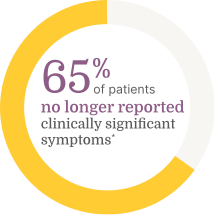
In patients with anxiety or depression, 65% no longer reported clinically significant symptoms after 5 visits.
Why see a psychiatrist

Mental health is complex
Different conditions can have similar symptoms. A psychiatrist can provide a full examination so you get an accurate diagnosis.

Treatment plan
Work on a way forward that fits your needs and preferences. If it’s right for you, this can include medication.

Get your questions answered
Care is a conversation. No online test can give you level of dialogue you need to make informed decisions about your care.

Psychiatrists are specialists
Psychiatrists are medical doctors who specialize in mental health. They can take a holistic look at your symptoms to eliminate possible physical causes, too.
As seen in


Frequently asked questions
Does Talkiatry take my insurance?

We're in-network with major insurers, including:
- Aetna
- Blue Cross Blue Shield
- Cigna
- Humana
- Oscar
- United Healthcare
- Optum
- Compsych
Even if your insurer isn't on the list, we might still accept it. Use our insurance eligibility checker to see if we take your plan.
Can I get an estimate of my visit cost?
The best way to get a detailed estimate of your cost is to contact your insurance company directly, since your cost will depend on the details of your coverage.
For some, it’s just a copay. If you have an unmet deductible, it could be more.
Call the number on your insurance card and ask about your plan’s coverage for outpatient psychiatric services.
Who is Talkiatry for?
Talkiatry is for anyone who is struggling with their mental health. We’re a psychiatry practice that provides virtual, in-network psychiatry.
What we specialize in:
- Anxiety
- ADHD (attention-deficit hyperactivity disorder)
- Bipolar disorder
- Child & adolescent care
- Depression
- OCD (obsessive-compulsive disorder)
- Pregnancy & postpartum care
- PTSD (post-traumatic stress disorder)
- Substance use disorder
We also treat related conditions (like adjustment disorders). Our goal is to connect you with the best possible care for you. If that’s not with us, your doctor will let you know and provide recommendations for where to find resources that are the best fit for you.
If your mental health is making it hard to go about your day, let’s talk. Take our 10-minute online assessment to see if Talkiatry is right for you.
How does Talkiatry compare to face-to-face treatment?
For most patients, Talkiatry treatment is just as effective as in-person psychiatry (American Psychiatric Association, 2021), and much more convenient. That said, we don’t currently provide treatment for schizophrenia, primary eating disorder treatment, or Medication Assisted Treatment for substance use disorders.
What's the difference between a therapist and psychiatrist?
Psychiatrists are doctors who have specialized training in diagnosing and treating complex mental health conditions through medication management. If you are experiencing symptoms of a mental health condition such as depression, anxiety, bipolar disorder, PTSD, or similar, a psychiatrist may be a good place to start.
Other signs that you should see a psychiatrist include:
- Your primary care doctor or another doctor thinks you may benefit from the services of a psychiatrist and provides a referral
- You are interested in taking medication to treat a mental health condition
- Your symptoms are severe enough to regularly interfere with your everyday life
The term “therapist” can apply to a range of professionals including social workers, mental health counselors, psychologists, professional counselors, marriage and family therapists, and psychoanalysts. Working with a therapist generally involves regular talk therapy sessions where you discuss your feelings, problem-solving strategies, and coping mechanisms to help with your condition.
Who will I be matched with?
It’s our mission to connect you with the best possible care. We have more than 800 psychiatrists on staff. To narrow down the possibilities and zero in on the right clinician for you, we use our online assessment. Here are the criteria it uses for finding you a match.
Location: Even though we’re a virtual practice, your psychiatrist needs to be licensed to practice medicine in the state you live in.
Age range: Psychiatrists specialize in treating specific age ranges (i.e. child, adolescent, adult, senior). We’ll only show you psychiatrists who are a fit for you.
Reason for your visit: In the assessment, we’ll ask some questions about why you’re seeking care. We use that to help find a psychiatrist who can diagnose and treat you. Mental health diagnoses can be complicated and symptoms can overlap. After your initial evaluation, if your psychiatrist thinks a psychiatrist with a different specialty is a better fit, we’ll connect you with one.
But we understand that mental health care is personal. If you’re unhappy with your doctor, we’ll help you find a different one. Call us at 833-351-8255 or email hello@talkiatry.com and we’ll rematch you.
Who can prescribe medication?
All our psychiatrists (and all psychiatrists in general) are medical doctors with additional training in mental health. They can prescribe any medication they think can help their patients. In order to find out which medications might be appropriate, they need to conduct a full evaluation. At Talkiatry, first visits are generally scheduled for 60 minutes or more to give your psychiatrist time to learn about you, work on a treatment plan, and discuss any medications that might be included.
Does Talkiatry prescribe controlled substances?
The short answer is that it depends on your state’s laws. All our psychiatrists (and all psychiatrists in general) are medical doctors. This means that they can prescribe any medications they believe are appropriate for your care. That’s simple.
Where it gets more complicated is with state laws. Certain states require you to have an in-person visit with your doctor before they can prescribe controlled substances. Since we’re a virtual practice, we can’t always meet this requirement.
In order to be prescribed a controlled substance at Talkiatry:
- Your psychiatrist has to believe these medications are appropriate for you after they provide an initial evaluation, diagnosis, and treatment plan. (If you’re interested in setting up a visit, start with our online assessment.)
- Your state’s laws need to allow doctors to prescribe controlled substances without an in-person visit.
If you’re currently taking a controlled substance, there’s no guarantee your Talkiatry clinician will agree with your past doctors on your condition or on the treatment plan you’re currently on. As medical practitioners, our doctors must provide their own examinations to determine what they recommend for you.
Is my information kept private?
We take our responsibility to safeguard our patients' privacy incredibly seriously. This commitment applies throughout each patient's journey at Talkiatry and after they leave our practice.


*65% of patients no longer reported clinically significant symptoms; Person C, O'Connor N, Koehler L, Venkatachalam K, Gaveras G; Evaluating Clinical Outcomes in Patients Being Treated Exclusively via Telepsychiatry: Retrospective Data Analysis; JMIR Form Res 2023;7:e53293; URL:https://formative.jmir.org/2023/1/e53293 DOI: 10.2196/53293. Outcomes data based on retrospective study of de-identified data from 1,826 Talkiatry patients who completed GAD7 or PHQ8 at their first visit and one subsequent visit. The first visit was between 2/1/23 and 5/26/23. ‘Not clinically significant' defined as a GAD7/PHQ8 score less than 10.